Pre-Construction Anti-Termite Treatment in Kerala: What Every Homeowner and Builder Must Know Before Laying the Foundation
Introduction
You have spent months choosing the right plot, finalising the floor plan, and negotiating with contractors. The foundation is almost ready. But there is one critical step that far too many Kerala homeowners skip — or discover only after the damage is done.
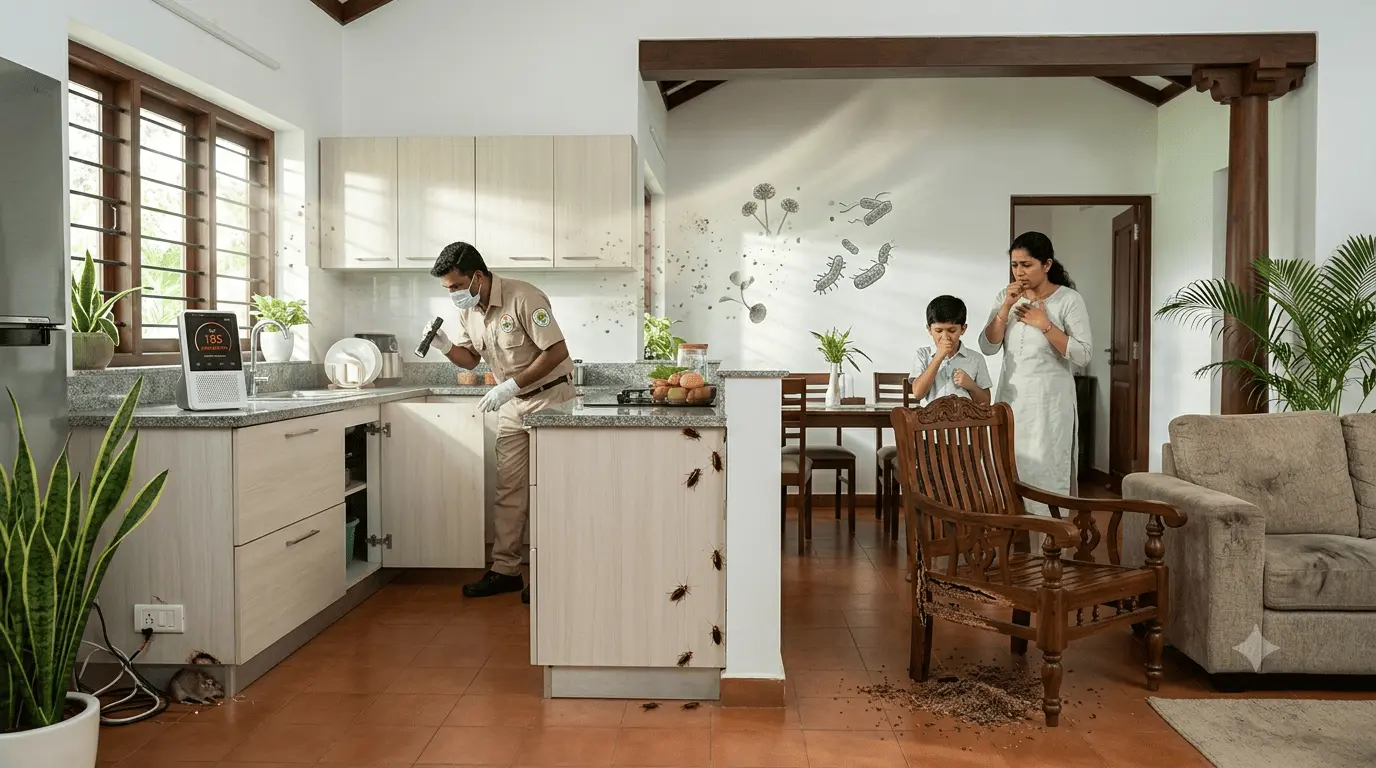
Termites.Kerala's warm, humid climate and heavy annual monsoon create near-perfect conditions for termite colonies to thrive. These insects do not wait for your home to be fully built before they move in. They enter through the soil beneath your foundation, travel silently through concrete cracks and expansion joints, and begin destroying your woodwork, furniture, and structural elements — often before you notice a single sign.
The good news is that there is a highly effective, legally recognised solution: anti-termite treatment for new construction in Kochi and across Kerala, applied at the right stage of building. Done correctly, it creates an invisible chemical barrier beneath and around your home that keeps termites away for up to ten years.
This guide covers everything you need to know — why this treatment is not optional, how it works at each construction stage, what chemicals are used, how much it costs, and what to ask your contractor before work begins.
Why Kerala Homes Face a Higher Termite Risk Than Most of India
Kerala's geography and climate work together to make termite infestation particularly likely. The region's tropical climate, heavy monsoons, and elevated humidity create conditions that termites thrive in. Subterranean termites — the most destructive species found in Kerala — live in soil colonies and use moisture to travel upward through mud tubes toward any wood they can find.
Several local factors amplify the risk further. Laterite soil, which is extremely common across Ernakulam, Thrissur, Palakkad, and Thiruvananthapuram districts, retains moisture long after the rains stop. This keeps the ground damp and warm — exactly the environment subterranean termites need to build large, active colonies. Kerala's tradition of using teak, rosewood, and other premium hardwoods in doors, window frames, staircases, and ceilings also gives termites more to target once they find a way in.
What makes this especially dangerous is how silently it happens. Termites can infest a property for months or even years without leaving obvious signs, operating in stealth and causing extensive structural damage before their presence becomes noticeable. By the time hollow-sounding wood or mud tubes appear, a colony may already have compromised load-bearing elements in the home.
The solution must begin before the foundation is even laid.
What Is Pre-Construction Anti-Termite Treatment?
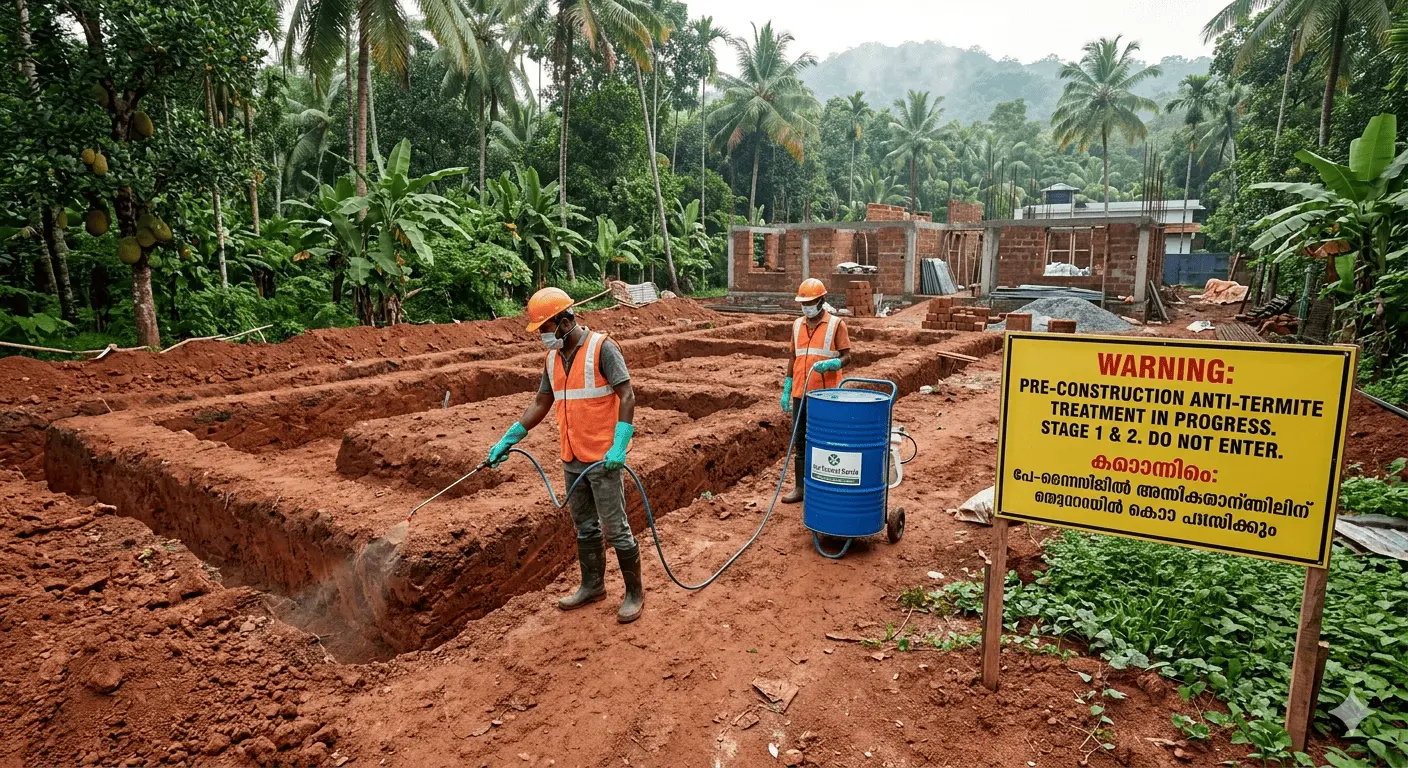
Pre-construction anti-termite treatment is a soil-based chemical barrier applied during specific stages of construction — after excavation and before the floor slab is poured. The treatment saturates the soil beneath and around the foundation with approved termiticide chemicals, creating a continuous underground barrier that termites cannot cross without absorbing a lethal dose of the chemical.
The purpose of this treatment is to create a chemical barrier in the soil around and beneath the foundation against termites, and when done correctly it carries a service warranty of up to ten years.
The key advantage over post-construction treatment is access. During construction, the soil beneath your home is fully exposed and reachable. Once the slabs are laid and walls are up, technicians can no longer reach the soil directly and must drill holes through finished floors and walls — a disruptive, more expensive, and less complete process.
In short, the construction phase is the only window when a truly comprehensive chemical barrier can be created. Missing it means either accepting a permanent risk or paying significantly more for a partial solution later.
Is Anti-Termite Treatment Legally Mandatory in India?
Yes. Many homeowners believe this is optional or left to the contractor's discretion. It is not.
Anti-termite treatment for new buildings is governed by IS 6313 Part II (2015), which is a Bureau of Indian Standards code of practice covering soil treatment using approved chemicals in foundation trenches, plinth beams, plinth filling, wall-floor joints, and expansion joints.
Most municipal corporations and building approval authorities across Kerala — including GCDA and various panchayat bodies — require compliance with IS 6313 as part of the construction approval process. Public works projects run by the Kerala PWD and KSRTC routinely include anti-termite treatment as a mandatory line item in tender documents.
For homeowners, the practical implication is simple: if your contractor tells you this treatment is optional, or suggests doing it after construction is complete, that is a serious oversight worth questioning. Always ask for a completion certificate and treatment warranty document as part of your possession handover.
How Pre-Construction Anti-Termite Treatment Works: Stage by Stage
The treatment follows a precise sequence that mirrors the construction timeline. Each stage treats a specific zone of the building's substructure, and together they form a continuous barrier with no gaps for termites to enter.
Stage 1 — Site Preparation
Before any chemical is applied, the site must be cleared. All organic matter, construction debris, and rubbish must be removed from the site, and the soil must be clean and dry before treatment begins. Treatment should never be carried out when it is raining or when the soil is wet or saturated.
Stage 2 — Foundation Trench and Pit Treatment
This is the first and most critical stage. The excavated foundation trenches and pit surfaces are treated with anti-termite chemical emulsion at a rate of five litres per square metre of surface area, applied to the bottom and sides up to a height of 300 mm from the base. For RCC foundations and pile caps, the treatment extends to a depth of 500 mm, with the chemical solution applied at 7.5 litres per square metre.
Stage 3 — Backfilling Treatment
As excavated soil is returned to the trench, it is treated before compaction. Backfilling is treated at 7.5 litres per square metre of the vertical surface of the substructure, and special care is taken to maintain continuity of the vertical soil barrier on inner wall surfaces from ground level upward.
Stage 4 — Plinth and Floor Surface Treatment
Once backfilling is compacted, the top surface of the plinth area is treated before the sub-grade floor is laid. The top surface of the consolidated earth within the plinth walls is treated at five litres per square metre of surface area. If the filled earth is well-rammed and the emulsion cannot seep through naturally, holes of 50–75 mm depth are made with a 12 mm steel rod at 150 mm intervals and the chemical is poured into these holes.
Stage 5 — Wall-Floor Junction and Expansion Joint Treatment
This stage addresses the most common entry points for termites — the gaps and joints where walls meet the floor. A small channel of 30 mm × 30 mm is cut at all wall and column junctions with the floor before the sub-grade is laid. Rod holes are made 150 mm apart down to ground level and chemical emulsion is poured at 7.5 litres per square metre of vertical surface, ensuring the soil is soaked all the way to the bottom. Expansion joints receive the same targeted treatment.
Stage 6 — Barrier Integrity and Re-treatment
If treated soil barriers are accidentally disturbed during subsequent construction work, the barrier must be repaired immediately to restore its continuity and completeness. If rain falls immediately after treatment and before the emulsion has been absorbed, the affected areas must be re-treated.
This last point is worth noting: unlike many construction processes, termite treatment requires the contractor to monitor weather conditions before and after application. Responsible pest control firms will schedule treatment carefully and confirm absorption before allowing construction to continue.
What Chemicals Are Used — and Are They Safe?
The chemicals used in professionally conducted anti-termite treatment for new construction in Kochi are regulated by the Central Insecticide Board (CIB) of India and must comply with IS 6313 Part II standards. The most commonly used termiticides today include:
Imidacloprid, a newer-generation neonicotinoid that offers effective protection with a lower environmental impact; Bifenthrin, a synthetic pyrethroid that provides long-lasting residual action; and Fipronil, which is highly effective at low concentrations and has transfer effects within termite colonies.
Older organochlorine compounds like Aldrin, Heptachlor, and Chlordane, which were historically used, are now banned in India due to their environmental persistence.Reputable pest control providers in Kochi only use currently approved chemicals.
On the question of safety: when applied by licensed professionals and allowed to dry completely before construction continues, these chemicals remain deep in the soil and pose no ongoing risk to residents. CIB-certified chemicals are applied using low-pressure injection methods to ensure deep soil penetration and maximum protection without fumes or surface residues. Infomaze
Pre-Construction vs Post-Construction Treatment: A Clear Compariso
Factor Pre-Construction Post-Construction
Best time During foundation / plinth stag After full construction
Soil access Complete Requires drilling through floors and walls
Disruption to home Zero Moderate to significant
Barrier completeness Maximum — no gaps Good, but barriers may have entry points
Cost Lower Considerably higher
Warranty period Up to 10 years Typically 3–5 years
The message here is straightforward. Anti-termite treatment for wood and structures can protect your property for a minimum of five years, and a comprehensive pre-construction treatment can extend this protection to a decade — at a fraction of the repair cost if termites are allowed in.
How Much Does Anti-Termite Treatment for New Construction Cost in Kochi?
Cost is one of the most common questions homeowners have, and the answer depends on the built-up area, soil type, treatment method, and the pest control provider. As a general guide, anti-termite treatment in Kerala costs between ₹10 and ₹12 per square foot, and the normal rate for a 1,000 sq. ft. home starts from around ₹10,000.
For a typical Kerala home of 1,200–1,800 sq. ft., this usually works out to approximately ₹12,000–₹22,000 for a complete pre-construction treatment with a warranty certificate. Premium methods such as the Anti-Termite Piping System (ATPS), which installs underground PVC pipes for periodic chemical reinjection without floor drilling, cost more but offer long-term convenience.
Compare this with what you stand to lose. Delayed action against termites can result in substantial financial losses, as repairing termite-induced damage is not only expensive but also time-consuming. Replacing termite-damaged teak doors, window frames, staircases, and wooden ceilings in a Kerala home can run into several lakhs of rupees — many times the cost of prevention.
Professional pest control in Kochi is well worth the investment when viewed this way.
A Checklist for Homeowners and Builders
Before your contractor proceeds past the foundation stage, confirm the following:
✅ Anti-termite soil treatment is included in the construction contract as a line item, not an afterthought
✅ The pest control company is licensed and registered — ask for their CIB registration or Indian Pest Control Association membership
✅ Chemicals being used are IS 6313 Part II compliant and CIB-approved
✅ Treatment will be carried out at all required stages — foundation trenches, backfilling, plinth surface, and all wall-floor junctions
✅ A written completion certificate and warranty document will be provided at handover
✅ Re-treatment will be carried out if rain falls before the emulsion is absorbed
✅ Treatment will NOT be done in rainy conditions or on wet, saturated soil
If your contractor cannot confirm all of these points, consider engaging a certified pest control provider independently rather than leaving it to a sub-contractor unfamiliar with IS 6313 requirements.
Is anti-termite treatment compulsory for all new buildings in Kerala?
Yes. Pre-construction anti-termite treatment is governed by IS 6313 Part II under Bureau of Indian Standards guidelines and is required for all new construction. Most Kerala municipal corporations and panchayat building approval processes expect compliance, and public sector construction projects mandate it in tender documentation.
Can anti-termite treatment be done after the house is built?
It can, but it is far less effective and more expensive. Post-construction treatment requires drilling through finished floors and walls to reach the soil, which is disruptive and cannot achieve the same complete, seamless barrier that pre-construction soil treatment provides. If you have already moved in and missed the pre-construction window, professional pest control in Kochi can still treat your home — but the earlier, the better.
How long does pre-construction anti-termite treatment last?
When carried out correctly using CIB-approved chemicals and following IS 6313 guidelines, pre-construction treatment typically provides protection for up to ten years. A reputable provider will issue a written warranty for this period. Annual inspections are still recommended to check for any breach or re-infestation.
Is the treatment safe for children and pets?
Yes, when conducted by licensed professionals using approved termiticides. The chemicals are injected deep into the soil beneath the structure. Once absorbed and the construction is complete, there is no exposure risk for residents. Modern termiticides like Imidacloprid and Fipronil are specifically chosen for low toxicity to mammals while being highly effective against termites.
What happens if it rains right after treatment?
If rain falls immediately after treatment and before the chemical emulsion has been absorbed into the soil, the affected areas must be re-treated. This is a standard requirement under IS 6313, and a professional provider will monitor post-treatment conditions and schedule re-application if necessary.
How do I know if my contractor actually did the anti-termite treatment?
Ask for a completion certificate from the pest control company, not just the civil contractor. The certificate should include the chemicals used, application rates, areas treated, and the date of treatment. Also ask for the IS 6313 Part II compliance confirmation and a warranty document. This documentation protects you legally and ensures you have recourse if termites appear within the warranty period.
Can I do anti-termite treatment myself to save money?
No. IS 6313 requires treatment to be carried out by licensed and authorised professionals. DIY attempts using off-the-shelf sprays cannot achieve the correct penetration depth, application rates, or barrier continuity required for genuine protection. Given that the cost of professional treatment is relatively modest compared to potential damage, this is one area where professional service is non-negotiable.
Does anti-termite treatment work on apartments and multi-storey buildings?
Yes. The treatment is applied at the foundation level regardless of how many floors will be built above. For apartment complexes, the developer or builder is responsible for ensuring IS 6313 compliant treatment across the entire footprint of the building. Flat buyers should request the building's treatment certificate as part of their due diligence before possession.
Conclusion
Building a home in Kerala is a significant investment — financially, emotionally, and in terms of years of planning. Pre-construction anti-termite treatment is the one step that protects all of that investment at the very foundation, literally and figuratively.
Kerala's climate is not forgiving to untreated structures. Homeowners across Kochi, Ernakulam, and Thrissur should treat termite protection as a non-negotiable part of construction, given the region's humidity and soil conditions. And with IS 6313 making it a legal standard, there is no reason for any new construction to skip this step.